
Music Production Guides / Ambient music
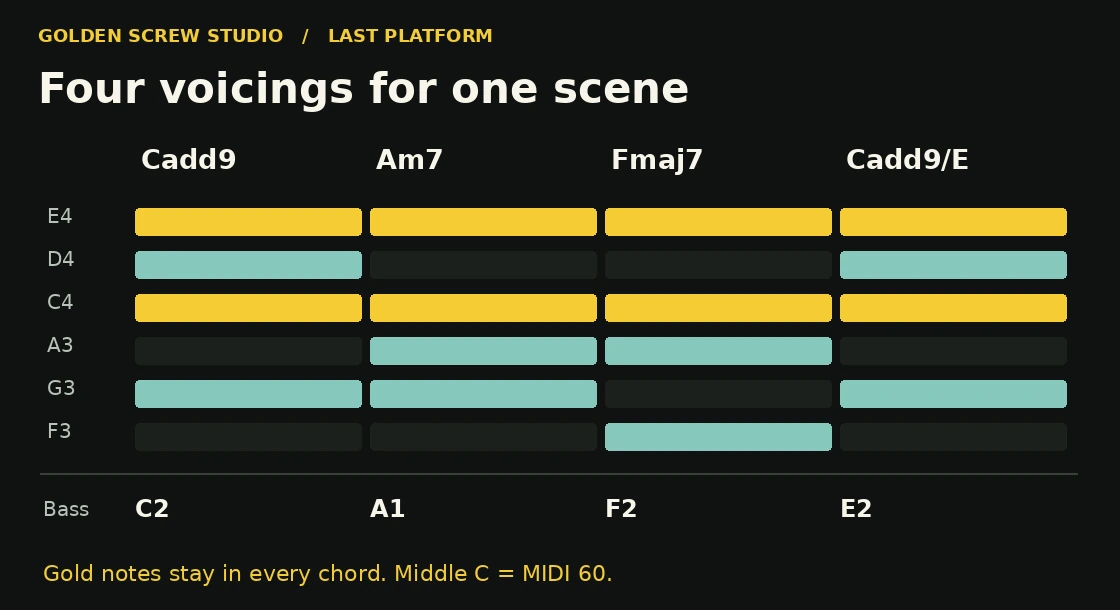
Keep two notes under your fingers and change the bass beneath them. C and E can belong to C major, A minor and F major. The ear has something to hold onto even when the floor of the chord moves.
Which notes should I actually play?
Start with a plain piano sound. Hold G3, C4, D4 and E4 over a low C. Keep C4 and E4 for the next chord, move D4 down to A3, hold G3 and put A in the bass. The first chord has a major colour with an added ninth. The second spells Am7. On a keyboard, try playing only the upper C and E while your left hand switches bass notes.
For the third chord, use F3, A3, C4 and E4 above F2. The E against F gives Fmaj7 its particular tension. Return to the first upper voicing for the fourth chord and put E in the bass. Play each shape for four bars. The cue below uses all four in that order.
Download the three-part MIDI (ZIP)
Why do the same chords sound jumpy in my patch?
Turn the reverb off and shorten the attack. Play the change on piano first. If the upper line leaps, move the leaping note to the nearest octave that still belongs to the chord. Now bring back the pad. If the jump appears only with the pad, listen for pitch motion on the attack, a retriggered filter envelope or a sudden change of brightness with velocity.
A close D and E in the middle register can make a gentle rub. Take that pair down two octaves and it may fill the space where the bass needs definition. Try moving only the upper pair back up while holding the root down. Judge it with the bass switched on.
How do I stop one chord smearing into the next?
Loop the last bar of Am7 into the first bar of Fmaj7. Let C and E ring. Shorten the notes that change by an eighth note and listen again. At 72 BPM an eighth note lasts roughly 417 ms, enough room to hear whether the old harmony clears. If every voice fades and swells together, tie or sustain one common tone through the boundary.
How do I make an ending more open?
Record two endings with identical pad notes. In take A, play C2 underneath. In take B, play E2, then stop. Hide the track labels and choose the one that suits your scene. For a waiting scene, a fully settled chord can resolve the story a few seconds too soon.
If you work in Serum 2, try the MIDI with a suspended pad from Equilibrium, with its internal effects bypassed for the first pass. Hear the Equilibrium Bundle. For the next step, give the held notes some movement.