
Music Production Guides / Ambient music
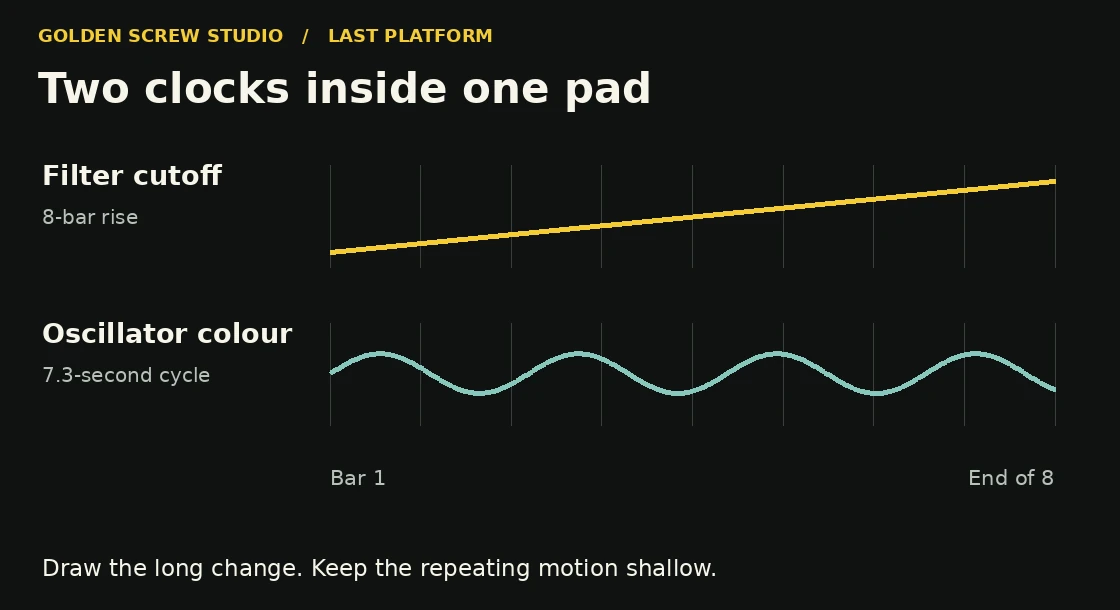
A pad can move constantly and still feel stuck. Give it a destination first. For the station scene, the sound should open up as the light approaches, then settle under the melody. An eight-bar filter rise can tell that story with a single held chord.
How do I build the pad from an initialized patch?
In Vital, start with one saw-like wavetable and a low-pass filter. Hold C, E and G in the middle of the keyboard. Set the amp envelope to sustain fully, try an attack around 600 ms and a release around 1.5 seconds. Listen across a chord change and shorten the release if the previous root hangs over the new bass.
Bring the oscillator up from one voice to three with a small amount of detune. Collapse the track to mono and listen to the centre note. If it goes thin or wobbles in pitch, back the detune down. Restore stereo and compare at the same perceived volume.
What should I automate?
Map a macro to filter cutoff. On a dark saw pad, try moving from roughly 500 Hz to 2 kHz as a starting sweep. Play the last two bars underneath the motif. Set the macro ceiling at the point just before the high notes begin to disappear behind the pad. Draw one rise across eight bars and leave the first two bars almost still.
For the small internal motion, choose a wavetable whose adjacent frames sound related. Set a smooth LFO in seconds, try a 7.3-second cycle, and route a small amount to wavetable position. If a single note sounds like a repeated vowel, reduce the modulation depth. With a fixed-shape oscillator, send the same LFO lightly to the filter instead.
Why can I hear the modulation restarting?
Hold the same chord for two bars, release it, and play again. If every note has the same obvious swell, listen to the LFO retrigger mode. A free-running or unsynced phase can let a new note begin partway through a cycle. Keep the amplitude envelope retriggered if the entrance still needs a clear shape.
How can a static chord feel less repetitive?
Brian Eno described using separate tape loops of piano and sustained voices for Music for Airports and allowing their overlaps to change. Try the principle with two clips, one five bars and one seven. With a shared downbeat their starts line up again after 35 bars. Leave rests in each clip so you can hear the changing overlaps. Read Eno’s account in Interview.
For a quicker sound-design pass, open a Serenity pad and a Horizon texture from the Super Ambient Bundle. Hold the same MIDI chord on both and choose the sound whose movement leaves room for your motif. Listen to the Super Ambient Bundle for Vital. Hear the pad in the finished scene.