
Music Production Guides / Cinematic music
Keep playback volume fixed and hold a low D. Leave four beats of space, then play a short A above it. Repeat the A closer to the next downbeat each time. You can make a listener anticipate an event with timing alone, before a single drum arrives.
What can replace a drum build?
Draw eight bars at 72 BPM. In bars 1–2, let the drone establish the room. Put a narrow high pulse on beat one of bar 3 and another on beat one of bar 4. In bar 5 make it two pulses, on beats one and three. Leave the bass at the same level. The shorter time between events should make the room feel less settled.
In bars 6–7, introduce an E-flat above the low D for one beat at a time. Keep it high and quiet at first. Move it down an octave as a comparison. The register changes how the semitone relationship is felt. Mute it entirely to check whether timing alone was enough.
How do I add weight without making the master louder?
Split a simple midrange tone into a clean path and a parallel distortion path. On the second path, high-pass out the bottom, add drive, then bring its output back down before blending. Keep the low D clean. Automate only the processed path into the last two bars. Compare the clean and driven versions at matched loudness and listen for extra harmonics anchoring attention.
In his DOOM work, Mick Gordon describes feeding a simple source through parallel processing and treating the resulting sound as an instrument. For this exercise, record your own tone through two contrasting chains, keep the most expressive second and play it back from a sampler. That small experiment translates to a quiet score as well as industrial metal. Hear Gordon discuss the instrument and routing on URM.
Where should the tension release?
Mute the moving layer for the last beat of bar 7. On bar 8 try three endings while leaving the picture alone. One restores the original A, one resolves E-flat down to D, one leaves the frame silent. The silent ending often changes how the audience reads the next sound. Play all three against the cut.
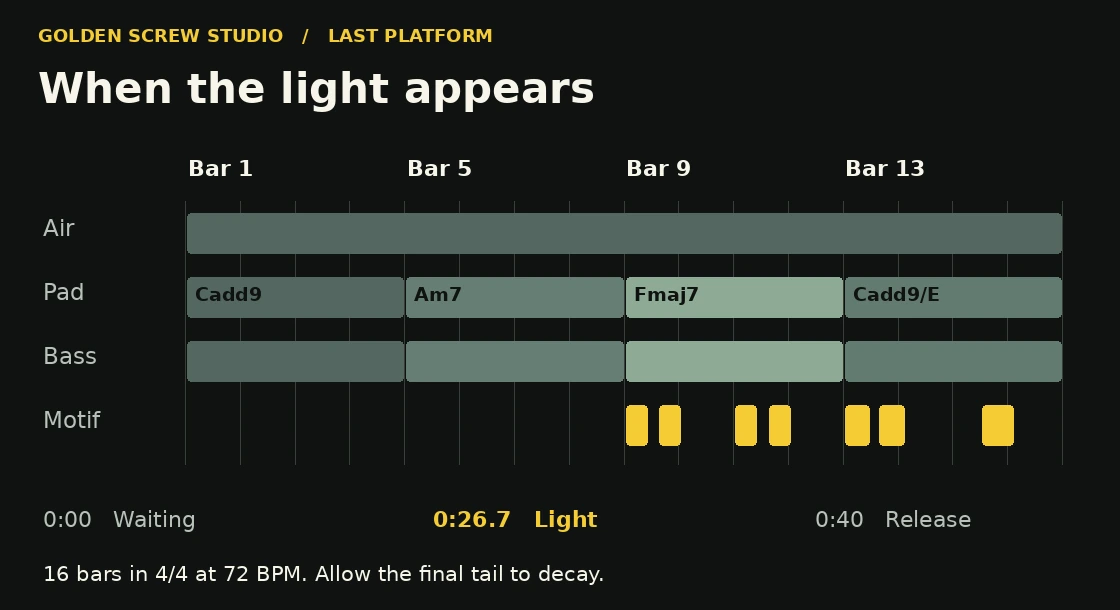
To try a second tone palette, use a Dune bass and a Horizon lead from the Cinematic Expansion Bundle. Keep the MIDI fixed for the comparison. Audition the three Vital expansions. Place the release against a precise picture cue.